
Case Study: Food and Beverage
Zero Waste-to-Landfill
No matter how big a business might be, or how many resources it has access to, achieving zero waste-to-landfill is rarely a simple task. In reality, it may be even more difficult for larger companies to reach this milestone due to the fact that they typically produce more waste streams with more variations in scale, makeup and complexity than their market peers.
It was no different for this leading food and beverage manufacturer, and at the end of the day, they had a lot to consider.
Still, despite how challenging or uncertain the path before them was, their ambition was clear—they wanted to reduce the environmental impact of their business, they wanted to optimize their efficiency, and they wanted to do it by reaching for the coveted status of being a zero waste-to-landfill business across their North American operations.
Every facility had unique needs. Variables like assets available, product lines, geography and local policies are just some of the differing factors to consider.
The Need for a Multi-Faceted Approach
Securing a zero waste-to-landfill status across North America, especially with a number of diverse divisions and product lines to account for, posed several challenges from the start.
Firstly, as expected, this producer had many complex solid and liquid waste streams. From expired products and damaged goods, to specialized materials like packaging and labeling components, there was a great deal of variation amongst their materials.
Some required very specific capabilities to solve for them, others required a mix of several, and some lacked clear avenues for sustainable waste management entirely.
Secondly, the logistics of rolling out a zero waste-to landfill program was a colossal task. This manufacturer had nearly 60 large facilities scattered across the continent, and each one had to work toward sustainability while satisfying their own unique management and transportation needs. While some dissimilarities stemmed from the type of facilities and product lines in question, others resulted from being in vastly different locations and having to consider the geographic factors and regional policies that come with that.
Lastly, was fully aligning those individual needs and sustainability efforts to the company’s overarching business goals. While some divisions were able to work toward their early targets more seamlessly, others faced greater and more frequent obstacles, highlighting the need for a consistent, scalable approach to meet their sustainability objectives—especially if they hoped to achieve a zero waste-to-landfill status.
After all, a chain is as strong as its weakest link, as they say, and reaching zero waste-to-landfill is no exception. The food and beverage manufacturer knew they were in an all-or-nothing endeavor— either they were a zero waste-to-landfill business, or they were not. To ensure they were the former, they entered a strategic partnership with ReworldTM to bring their sustainability efforts to the next level.
A chain is as strong as its weakest link, as they say, and reaching zero waste-to-landfill is no exception. You either are a zero waste-tolandfill business, or you are not
Going to the Next Level
After evaluating several options, the food and beverage manufacturer chose Reworld™ as their sustainable solutions partner due to their diverse, end-to-end capabilities and extensive experience in the industry. Unlike others in the market, Reworld™ offered a truly comprehensive approach that ticked all of the producer’s boxes.
The solutions provider had a wide range of in-house capabilities and assets that could handle the full and differing scope of the manufacturer’s needs. This meant that in the end, every waste challenge and uncertainty would have an appropriate answer.
There were advanced product de-packaging and recycling solutions that could repurpose various containers and their contents. There were powerful wastewater treatment capabilities through ReDrop™ , one of the sustainability partner’s key solutions. And there were even recovery options for landfill-destined waste that was unfit for further recycling. With these materials, the manufacturer was able to generate renewable energy (and today can create alternative engineered fuel through ReKiln™ ), solving for even the most difficult-to-manage materials.
Going a step further, the technology to deliver these capabilities exists all over the country. With more than 90 facilities and 2,000+ fully licensed vehicles Reworld™ has an enormous geographic footprint that can handle the manufacturer’s waste streams, no matter where they are.
Additionally, Reworld™ has long-established relationships with the regions they call home. That means they know their communities, they know their leaders, and they know the standards they must operate under to keep their customers compliant on federal, state and local levels.
This, coupled with another one of their comprehensive solutions, ReMove™ , allows Reworld™ to cover everything logistics-related from strategy development to paperwork and permitting to customized invoicing, dynamic tracking and thorough reporting.
But it was ReDirect360™ , the provider’s zero waste-to-landfill solution that tied it all together. Through it, Reworld™ was able to help the food and beverage manufacturer leverage the full scope of sustainable solutions available to them to ensure that their goals were clear and cohesive across their sites, that their unique needs were individually met, and that their efforts were synergized to deliver the best possible outcomes company-wide.
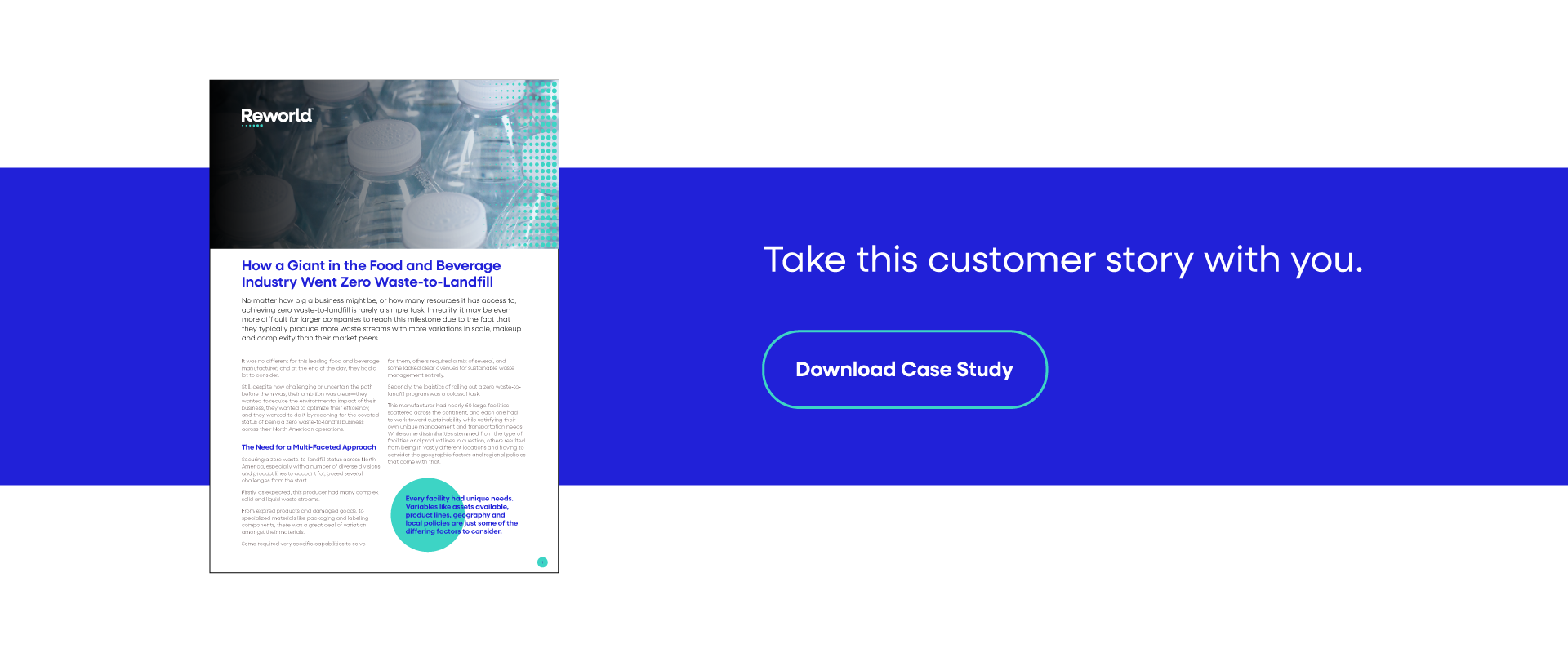
ReDirect360™ leverages the full scope of sustainable solutions offered by Reworld™ through a single solution that streamlines and synergizes sustainability efforts.
Finding Widespread Success
Ultimately, this partnership resulted in significant, positive impacts for the food and beverage manufacturer. Within every one of their divisions, the producer has achieved zero waste-to-landfill, demonstrating their resolve, innovative thinking and commitment to sustainability.
This achievement aligns perfectly with their goal of improving their environmental footprint by moving up the waste hierarchy and reimaging even the most “unsalvageable” of waste materials into valuable resources. Their new mindset, alongside the effort it fueled, has led the business to improved operations across the board.
They’ve become more conscious of the waste they generate and the ways in which they approach handling it. It’s created a culture of continuous improvement that has made its way into every area of their day-to-day.
With that, they continue to work closely with Reworld™ today, constantly exploring new solutions and refining existing strategies to further advance their sustainability goals and demonstrate that environmental stewardship and operational efficiency can, and should, go hand in hand—even when it is on a grand scale
